
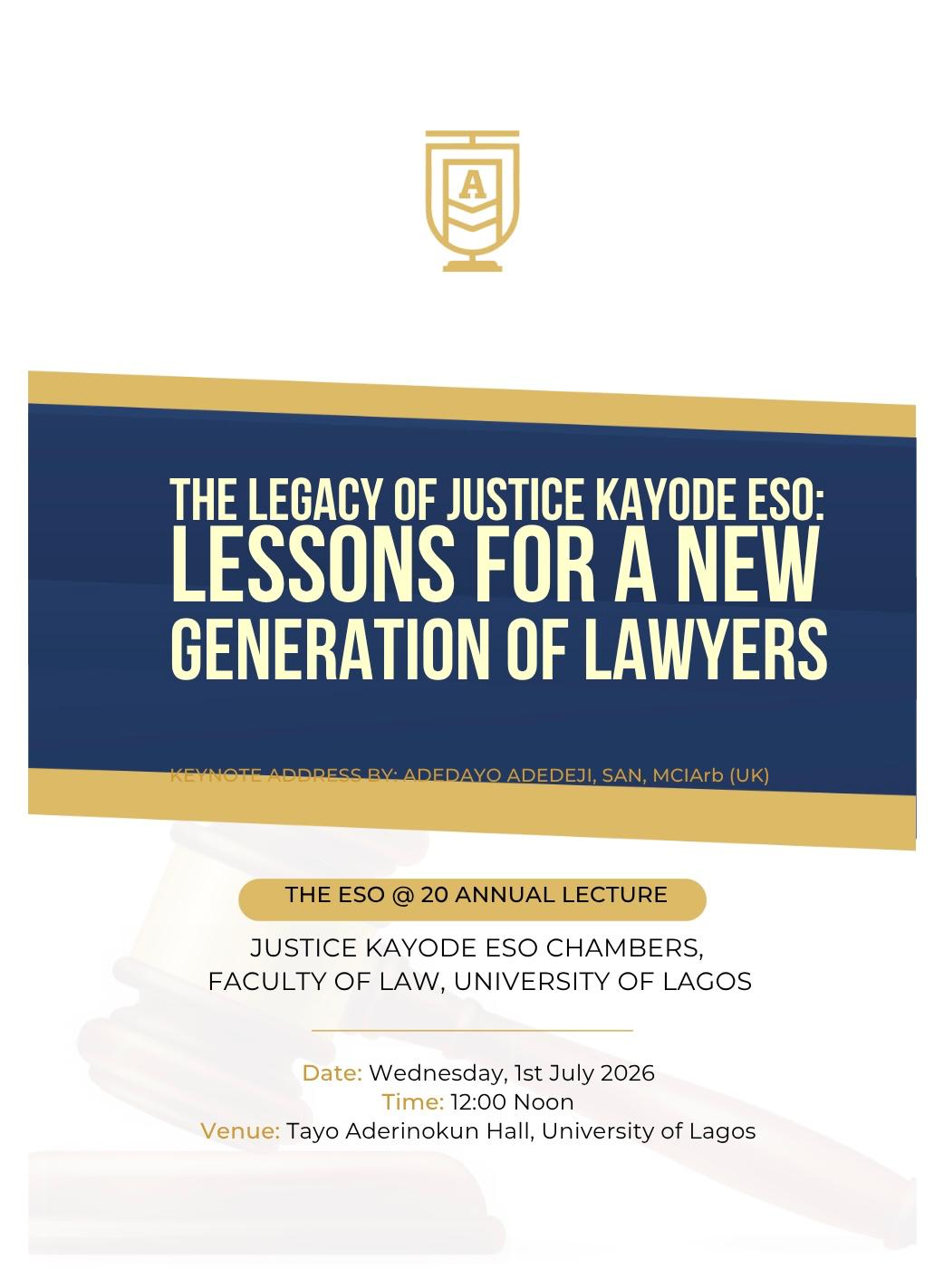
KEYNOTE ADDRESS BY ADEDAYO ADEDEJI, SAN, MCIArb (UK) ON THE OCCASION OF THE 20TH ANNIVERSARY OF THE JUSTICE KAYODE ESO CHAMBERS, FACULTY OF LAW, UNIVERSITY OF LAGOS ON THE 1ST OF JULY, 2026
Theme: Justice Without Compromise: The Legacy of Justice Kayode Eso and the Challenge Before a New Generation of Lawyers
Introduction
It is with enormous gratitude and a deep sense of nostalgia that I stand before you today as we commemorate the twentieth anniversary of one of the most respected and intellectually vibrant student law societies in Nigeria, the Justice Kayode Eso Chambers. For me, this is more than an invitation to deliver a keynote address. It is a homecoming.
Indeed, one of the reasons I consider it a special honour to deliver this keynote address is not merely because I count myself among the early members and builders of this Chambers. It is also not merely because I had the privilege of serving as its Executive President during my studentship. It is because, during that period, we were able to achieve what many considered impossible by inviting the late Honourable Justice Kayode Eso himself to this Faculty of Law. To the best of my knowledge, that visit remains his first and last official physical engagement with this Faculty before his passing. That singular experience remains one of the most treasured memories of my student years. I also acknowledge with pride, the contribution of my learned friend and Brother, Kehinde Akintola who we birthed the ideas and walked the walk together among other eminent colleagues to actualize our dreams for the Chambers during our time.
I recall with great nostalgia a visit some of us paid to Justice Kayode Eso at his residence in Ibadan sometime in 2006 while I was a 400-Level student. The purpose of that visit was simple but significant; it was to formally introduce the Chambers that proudly bore his name and to seek his blessings, guidance, and counsel.
As fate would have it, we also had the privilege of meeting another legal icon on that memorable day, Chief Mrs. Folake Solanke, SAN, the first female Senior Advocate of Nigeria.
At the time, I could never have imagined that one day I too would be privileged to wear the Silk. Yet, looking back now, I realise that what I gained from that visit was far more valuable than most things I have learnt in life.
What I gained were lessons; lessons on hard work, lessons on integrity, lessons on discipline, and quite importantly, lessons on character. Both Justice Eso and Chief Mrs. Solanke spoke to us with extraordinary candour about the demands of the legal profession. They reminded us that law is not merely a career. It is a discipline. It is a calling. It is a profession built on ethics, honour, learning, and personal responsibility.
I remember quite vividly that at a point during the interaction, one of us casually responded to a question with the expression, “Yeah.†the reaction was immediate. With firmness and elegance, they responded, “No, no, no, no. That is not the language of a lawyer.†The lesson was profound, they taught us that excellence in law begins long before one enters a courtroom. It begins with discipline in speech, discipline in conduct, discipline in thought, and discipline in character.
I recount these memories not merely to indulge in nostalgia or to entertain you with stories from another era. I recount them because they underscore a truth that every aspiring lawyer must understand; the legal profession is one profession in which ethical compromise eventually leads to professional ruin. It is a profession that demands discipline when nobody is watching, integrity when compromise appears attractive, and courage when doing the right thing comes at a cost.
Honourable Justice Kayode Eso embodied these virtues throughout his remarkable life. He was a man of uncommon courage. He was a man who spoke truth to power. He was a jurist who was never afraid to stand alone when principle demanded it. He was known throughout the legal profession as a man who said things exactly as he saw them, without fear and favour.
That, distinguished ladies and gentlemen, is how a lawyer should be. A lawyer must be guided by principle rather than popularity. A lawyer must be committed to truth rather than convenience. A lawyer must possess the courage to defend what is right, even when it is unpopular and even when he stands alone. That was the example Justice Kayode Eso gifted to us. That is the legacy this Chambers was founded to preserve. And that is the challenge that confronts every one of us today.
The theme of this anniversary, Justice Without Compromise, captures with accuracy the essence of Justice Kayode Eso's legacy. His Lordship belonged to that rare generation of jurists who understood that the law derives its legitimacy not merely from its technical correctness but from its capacity to deliver justice. He recognized that while the law provides the framework within which society operates, justice remains the ultimate objective of every legal system. The challenge before every generation of lawyers and indeed Judges of our various Courts, is to ensure that the pursuit of justice never becomes subordinate to convenience, expediency, popularity, or personal interest. That was the challenge of Justice Kayode Eso's generation. It should also be ours.
Now, let us go through the various areas of Justice Eso’s legacy together as follows:
The Legal Profession as a Revered Calling
Justice Kayode Eso viewed the legal profession through a lens that many today may consider old fashioned, but which remains relevant. He regarded law as a vocation of service rather than a commercial enterprise. In one of his memorable pronouncements, he reminded us that a lawyer is not merely a tradesman. The lawyer occupies a unique position in society because he serves simultaneously as an advocate for his client and as an officer of the court. That dual responsibility demands more than technical competence. It demands character. It also means that the legal profession cannot survive on intelligence alone. It requires integrity. It requires discipline. It requires fidelity to ethical standards. It requires courage to explore and contribute to the development of law and justice.
Justice Eso repeatedly lay emphasis on the fact that once counsel assumes responsibility for a matter, professional judgment must be exercised independently and thoroughly. He famously remarked in ADEWUNMI V. PLASTEX LTD. that: “A lawyer is not a trademan. He is not like a cobbler who deals with the awl and who can be jettisoned by a customer when the awl fails to perform. A lawyer is a professional and vis-a-vis a client he is on contract and his professional skill, hired by the client is to be employed at his discretion. Afterall all, he is employed to deal with learned men in learned surroundings and he himself is learned, which the client, even if he is a lawyer himself, is not learned for the purpose of the case."
To him, the lawyer's duty is not simply to please the client. The lawyer's duty is to act according to law, professional ethics, and sound judgment. This principle is perhaps more important today than ever before. We now live in an era where public opinion often seeks to influence legal outcomes. We now live in an age of instant commentary, social media outrage, and relentless pressure for immediate conclusions. Yet in the face of all these the lawyer must remain steadfast. The lawyer must be guided by principle rather than applause or grandstanding. The lawyer must remain committed to truth even when truth is unpopular. That was the standard Justice Eso demanded and that remains the standard worthy of our profession.
The Judge as the Guardian of the Rails of Justice
One of the most enduring contributions of Justice Kayode Eso to Nigerian jurisprudence was his insistence that judges are not passive spectators in the administration of justice. He rejected the notion that judges should function as mere mechanical interpreters of legal texts. He believed that adjudication requires intellectual courage. He believed that the law must be interpreted in a manner that addresses the realities of society. He believed that judges must possess sufficient moral imagination to ensure that the law remains relevant to contemporary challenges. His Lordship once warned against reducing judges to automatons in TRANS BRIDGE CO. LTD V. SURVEY INT. LTD. when he remarked thus: “It would be tragic to reduce Judges to a sterile role and make an automaton of them. I believe, it is the function of Judges to keep the law alive, in motion, and to make it progressive for the purpose of arriving at the end of justice, without being inhibited by technicalities, to find every conceivable, but acceptable way of avoiding narrowness that would spell injustice.â€
Those words remain significant till today. A legal system that divorces itself from the realities of human experience risks becoming detached from the society it exists to serve. Yet Justice Eso was equally conscious of the dangers that accompany judicial activism. He understood that judicial power must never become judicial arbitrariness. He appreciated that judges must remain faithful to established legal principles and constitutional boundaries. The following were his words in the case of SODIPO V. LEMMINKAINEN OY :
“A Judge exists to determine disputes and to examine with due care and miscroscopic sense all matters before him in his pursuit of justice. He is there not to trap any party or to set in motion what the parties have not brought before him. He is not the Grand Inquisitor envisaged by Dostoevesky in his Brothers Karamazov. He is a judge governed by rules.â€
For him, the solution lay in striking a careful balance between legal certainty and substantive justice. That balance remains one of the greatest challenges facing the judiciary today. The public expects judges to be fearless. The Constitution requires judges to be impartial. The law demands judges to be disciplined. As a matter of verifiable fact, the greatness of Justice Kayode Eso lay in his ability to embody all three.
Justice as the Ultimate Purpose of Law
Perhaps no aspect of Justice Eso's philosophy resonates more deeply than his commitment to justice itself. His Lordship understood that legal procedures, rules, and doctrines are not ends in themselves. They are instruments designed to achieve justice. Throughout his judicial career, he consistently reminded the bar and the bench that justice must never be sacrificed at the altar of technicality.
He believed firmly in the principles of fair hearing and natural justice. Indeed, he frequently drew attention to the fundamental notion that every person must be afforded an opportunity to be heard before a decision affecting their rights is taken.
His commitment to fairness was not theoretical. It was practical. It informed his judgments. It shaped his reasoning and ultimately, it influenced generations of lawyers and judges.
Justice Eso constantly reminded us that justice must not only be done; it must be manifestly and visibly seen to be done. in KADIYA V. LAR He stated thus “It is a primary axiom of our law that justice should not only be done but be glaringly seen to be done. Anything less than this will not serve the course of justice which this Court has full responsibility to guard most jealously.â€
This principle remains the foundation of public confidence in the administration of justice. Without public confidence, courts lose their moral authority. Without moral authority, the rule of law becomes vulnerable. Without the rule of law, democracy which we treasure so much is endangered.
A Personal Charge to the Next Generation
Since the majority of those gathered here today are law students, permit me to place the theme of this anniversary, "Justice Without Compromise," in a practical context that directly concerns your future.
Whenever I have the privilege of addressing young lawyers and law students, I often begin with a simple but profound question; why are you studying law? It appears to be a straightforward question, but I assure you that it is one of the most important questions you will ever answer.
Are you studying law because your parents wanted a lawyer in the family? Are you here because law appeared to be a prestigious course of study? Are you here because of the perceived social status associated with the profession? Or are you here because you genuinely possess a passion for justice, advocacy, problem solving, and service to society?
Your answer to that question will ultimately shape your attitude towards the law, your career, and your understanding of what it means to pursue justice without compromise.
The truth is that every lawyer will, at some point in his or her career, face difficult choices. You will be confronted with opportunities to compromise your principles for immediate gain. You will encounter situations where integrity appears expensive and compromise appears profitable. In those moments, what will sustain you is not merely your legal education but the values that brought you into the profession in the first place.
That is why self-discovery is so important. One of the greatest mistakes young lawyers make is approaching the profession with a “get rich quick†mentality. Justice Eso in deprecating this attitude had the following to say in the case of UDO V. STATE :
“Sometimes one wonders what is happening to the legal profession. In the tradition of the profession, one of the reasons for its being termed honourable is that counsel never complains of his fees. The tradition of having a small pocket in the Barrister's gown is that litigants used to put money there when argument proceeded in court. It used to be five shillings and it was honourable to receive such recognitionâ€
This is to say that while it is understandable that Lawyers have needs. Especially in this Economy, Law has never been a profession that rewards impatience. It is a profession that rewards consistency, discipline, learning, resilience, and reputation built over time.
The earlier you discover who you are and what aspect of the profession truly excites you, the better positioned you will be for long term success. Whether your passion lies in litigation, corporate practice, intellectual property, taxation, energy law, arbitration, academia, public policy, technology law, legislative drafting, compliance, or judicial service, identify it early and begin to deliberately build competence in that area.
Do not spend your years merely drifting through the profession. Develop a sense of direction. Equally important is the role of mentorship. No lawyer achieves greatness entirely alone. Every accomplished lawyer can point to individuals whose guidance, correction, encouragement, and example helped shape their journey. A good mentor shortens your learning period, broadens your perspective, and helps you avoid mistakes that experience alone might have taught at a much greater cost.
Therefore, seek mentors deliberately. Observe how they conduct themselves. Learn not only from their successes but also from their discipline, professionalism, and character.
Let me also dispel a misconception that sometimes exists among young lawyers. You do not have to become a Senior Advocate of Nigeria before you can be regarded as successful in the legal profession. The legal profession is far broader than the Inner Bar. There are exceptional corporate lawyers who never appear in court. There are outstanding academics who shape generations of lawyers through scholarship and teaching, you will agree with me that they are abound in this great Faculty. There are also accomplished in-house counsel, arbitrators, policy experts, judicial officers, technology lawyers, legal entrepreneurs, and public servants whose contributions to society are massive. The key is not necessarily the title you attain but the value you create, the excellence you demonstrate, and the impact you make.
Take for instance, every year, the Body of Benchers admits thousands of aspiring lawyers into the profession. That number underscores an important reality. Which is that a mere qualification is no longer enough. Possessing a law degree is no longer sufficient to distinguish you. The question is what makes you different? What skills have you developed? What expertise have you acquired? What value can you bring to a client, an organization, a court, or society at large?
One of the most consistent truths about life and legal professional success is that opportunities will always come. The real question is whether you will be equipped when they come. Opportunity favours preparation. The days when individuals waited to be spoon fed have long passed. The modern lawyer must be proactive. You must invest in yourself continuously. You must read beyond the classroom. You must pursue internships and practical exposure whenever opportunities arise. You must engage in purposeful mentorship. You must develop communication skills, writing skills, research skills, leadership skills, and technological competence.
The legal profession is evolving rapidly. Artificial intelligence, legal technology, digital evidence, data protection, fintech regulation, cybersecurity, and virtual dispute resolution are already transforming legal practice globally. The lawyer of tomorrow cannot afford to remain fastened to yesterday's methods. You must be willing to learn, adapt, and grow.
Yet, in the midst of all this ambition and pursuit of excellence, there is one thing that must never be sacrificed; your integrity. Indeed, excellence and integrity remain the foundation upon which enduring legal careers are built. However, achieving excellence in this profession requires more than talent or intelligence; it requires discipline, sacrifice, patience, and the willingness to embrace delayed gratification. The legal profession is not one where greatness is achieved overnight. It is a journey of continuous learning, deliberate improvement, and consistent commitment to the ideals of the profession. It is thus a marathon, and never a sprint.
There is a saying that “a tree which will stay long in the forest must take time to establish its roots.†This principle applies profoundly to the legal profession. A lawyer who desires longevity, relevance, and respect must first build a solid foundation of knowledge, character, competence, and discipline. Similarly, no one scratches the surface and expects to find gold. The treasures of this profession are not discovered by those who merely participate at the surface level; they are discovered by those who apply themselves fully, who are willing to study deeply, work diligently, and remain committed even when the rewards are not immediately visible.
You must therefore apply yourselves wholeheartedly to the cause of the profession. Do not measure your progress only by immediate success or recognition. Some of the greatest lawyers and jurists were built through years of preparation, perseverance, and quiet dedication before the world recognised their contributions.
This is the same principle that has defined the lives and careers of the great men and women who have shaped the legal profession. Justice Kayode Eso remains a beacon of justice even after his passing, not merely because he occupied the Bench, but because of the principles he represented. His legacy reminds us that greatness in law is not achieved by titles alone; it is earned through years of discipline, sacrifice, excellence, and an uncompromising dedication to the ideals of the profession.
As you prepare to take your place within this profession, the question is not simply whether you will qualify as legal practitioners, but what kind of practitioners you will become. Will your names be associated with excellence, integrity, and service? Will your contributions strengthen public confidence in the legal profession? The foundations you lay today through discipline, learning, and character will determine the legacy you ultimately leave behind.
Guard your name jealously. Protect your reputation rigorously. As young lawyers, ensure that your names never become associated with professional misconduct, ethical violations, dishonesty, or conduct unbecoming of a legal practitioner. Beyond the professional consequences, the emotional, psychological, and reputational damage that accompanies disciplinary proceedings can be devastating. Remember that your career is built on one decision at a time. The choices you make when no one is watching, the standards you maintain when there is no immediate reward, and the principles you uphold when compromise appears convenient are what ultimately define the lawyer you become. Character is not built in moments of convenience; it is revealed in moments of pressure.
The legal profession remains one of the few professions where your reputation often arrives before you do. People will trust you with their liberty, their businesses, their families, their properties, and sometimes, their lives. That trust must never be betrayed.
Finally, always remember that the law is ultimately about people. Behind every file is a human story. Behind every legal dispute is a family, a business, a community, or an individual whose life may be affected by the outcome. Behind every brief lies a human concern. Behind every judgment lies an opportunity either to restore dignity or diminish it. Behind every exercise of judicial power lies the possibility of strengthening public confidence in the rule of law.
The finest lawyers never lose sight of these realities. They understand that while statutes, precedents, and legal principles are indispensable tools, the ultimate purpose of law is service to humanity. That, in my respectful view, is the true meaning of Justice Without Compromise and that is the legacy of Justice Kayode Eso and the heritage of this Chambers.
Conclusion
Ladies and Gentlemen, the life of Honourable Justice Kayode Eso (of blessed memory) teaches us that greatness in law is measured not merely by professional accomplishment but by fidelity to principle. His Lordship demonstrated that courage and humility can coexist. He showed that scholarship and humanity are not mutually exclusive. He proved that law, at its best, remains one of society's most powerful instruments for advancing justice.
As we celebrate twenty years of the Justice Kayode Eso Chambers, let us recommit ourselves to the ideals that inspired its founding. Let us embrace integrity over expediency. Let us choose excellence over mediocrity. Let us pursue justice without fear and without compromise. If we do so, we will not merely honour the memory of Justice Kayode Eso. We will continue his work. And there can be no greater tribute to him than that.
I congratulate the past and present leadership of the Chambers, members, alumni, and well wishers of the Justice Kayode Eso Chambers on this significant milestone. May this Chambers continue to produce lawyers who will shape the future of our profession and strengthen the administration of justice in Nigeria. Happy Twentieth Anniversary. May the next twenty years be even more impactful than the first.
Thank you and God bless you all.